
Running in hot humid weather is harder than running in dry heat, and the reason is mechanical: sweat only cools you when it evaporates, and in high humidity it mostly does not. Expect to run 30 to 60 seconds per kilometre slower at the same effort. Expect recovery to take longer too — the heat is part of your training load, not a background condition.
Why Humidity Makes Training Harder Than Heat Alone
Your body sheds heat during exercise almost entirely through evaporation. Sweat absorbs heat from your skin as it changes from liquid to vapor, and that phase change is the cooling. Sweat that runs off your body without evaporating has done nothing except cost you fluid.
The Point Where Sweat Stops Cooling You
Evaporation depends on the air’s capacity to absorb more moisture. At 40% humidity, air takes up sweat readily. At 85%, which Ho Chi Minh City hits regularly during rainy season, it has very little capacity left.
This is why a 30°C run in Saigon feels considerably worse than a 34°C run somewhere dry. Your core temperature climbs because your primary cooling system is running at reduced capacity, and your heart rate rises with it — partly to move blood to working muscle, partly to push blood to your skin to shed heat. Those two demands compete.
Adjusting Pace and Expectations
The practical adjustment: run by effort or heart rate, not by pace. If your easy pace at home is 5:30 per kilometre, your easy effort here might produce 6:15, and that is correct rather than a decline in fitness.
The mistake is holding the old pace. Doing so converts an easy run into a threshold session, and the cost shows up as accumulated fatigue two weeks later rather than on the day.
Acclimatisation is real and takes roughly one to two weeks of regular exposure. Your plasma volume increases, you begin sweating earlier and more efficiently, and you lose less salt in sweat. If you have just arrived, the first fortnight is the worst it will feel — and the travel recovery guide covers what else the first week in this climate does to you.
How Much Longer Recovery Takes in This Climate
Training in heat adds cardiovascular strain, greater fluid and electrolyte loss, and higher core temperature than the same session would produce in cooler conditions. All three extend the time your body needs before it is ready to absorb another hard effort.
In practice, most people training seriously in Saigon need one more easy or rest day per week than they would in a temperate climate — or the same number of hard sessions spread across more days. Ignoring this produces a familiar pattern: three good weeks, then a fourth where everything feels heavy and paces drift without explanation.
The heat is training load. Count it.
DOMS: What It Is and How Long It Really Lasts
Delayed onset muscle soreness is the stiffness and tenderness that appears a day or two after unfamiliar or unusually hard work, particularly work involving eccentric contractions — running downhill, lowering weights, decelerating.
The 24–72 Hour Curve
DOMS follows a predictable timeline. It is usually absent immediately after training, appears 12 to 24 hours later, peaks somewhere between 24 and 72 hours, and resolves within five to seven days without intervention.
Two useful points. First, DOMS is not a measure of session quality — you can train productively with no soreness at all, and a session that leaves you wrecked is not automatically a better session. Second, it reduces sharply with repeated exposure. The same workout that crippled you in week one produces little soreness by week four.
Soreness vs Injury
The distinction matters more than anything else in this article.
| Feature | DOMS | Possible injury |
|---|---|---|
| Onset | Gradual, 12–24h after | Often sudden, during activity |
| Location | Diffuse, across a muscle belly | Specific point, often a joint or tendon |
| Symmetry | Usually both sides | Frequently one side only |
| Character | Dull ache, stiffness | Sharp, stabbing, or burning |
| With movement | Eases as you warm up | Persists or worsens |
| Timeline | Improves after 72h | Static or worsening |
Stop and get assessed if pain is sharp, located at a joint line, present on one side only, worsening rather than improving after three days, accompanied by swelling or instability, or if it changes how you walk. Training through those is how a manageable problem becomes a season-ending one.
Recovery Methods Ranked by Evidence
Recovery has attracted a large amount of marketing and a modest amount of evidence. Ranked honestly, from strongest support to weakest:
| Method | Evidence | What it actually does |
|---|---|---|
| Sleep | Strong | Where the majority of adaptation and repair occurs |
| Food and protein | Strong | Provides the raw material for repair; restores fuel |
| Rest days | Strong | Adaptation happens between sessions, not during them |
| Active recovery | Moderate | Increases blood flow; usually improves how you feel |
| Soft tissue work | Moderate | Reduces perceived soreness; unclear effect on performance |
| Compression garments | Weak–moderate | Small effect on perceived soreness |
| Cold water immersion | Mixed | Reduces soreness; may blunt strength adaptation if used routinely |
| Static stretching for DOMS | Weak | Little measurable effect on soreness |
Sleep
The single highest-value recovery input, and the least glamorous. Most repair and adaptation happens during sleep, and no supplement, garment or protocol compensates for consistently getting too little of it.
Sleeping well in this climate is its own challenge — the cooling your body needs to fall asleep is harder to achieve in a hot bedroom. That mechanism, and what to do about it, is covered in the sleep and stress guide.
Protein and Refuelling
Repair requires amino acids, and glycogen requires carbohydrate. Spreading protein across the day works better than concentrating it in one meal, and eating within a couple of hours of a hard session helps, particularly if you train frequently.
In heat, appetite often drops after training. Liquid calories are easier to get down than solid food when you are overheated.
Active Recovery
Easy movement the day after hard work — walking, easy spinning, swimming — usually leaves people feeling better than complete rest. Swimming is particularly good here because the water handles the cooling problem for you.
The rule is that active recovery must be genuinely easy. If it becomes a moderate session, it is training, not recovery.
Soft Tissue Work
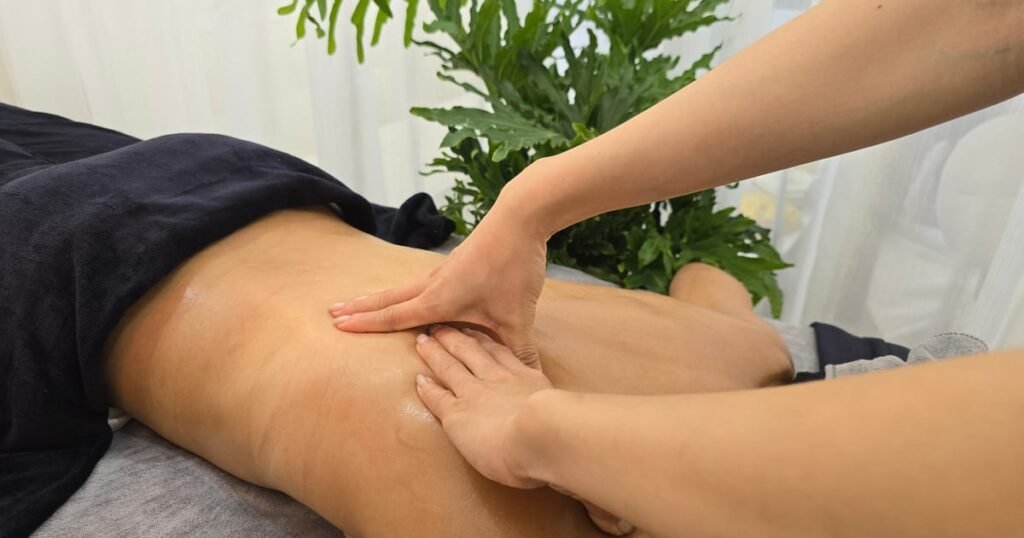
The honest position: massage has moderate evidence for reducing how sore you feel and reliably improves perceived readiness. Evidence that it restores measurable performance or clears metabolic by-products faster is weak — a position the US National Center for Complementary and Integrative Health reflects in its own summary.
That is still worth something. Feeling less sore means training more consistently, and consistency is what actually drives adaptation. Where it is most useful is with the specific tight, layered tissue that builds up over a heavy training block — deep tissue massage (60–90 minutes, 290,000 ₫ – 420,000 ₫) at Chạm Spa in District 1, Ho Chi Minh City works at that depth. What it will not do is substitute for the sleep you did not get.
Hydration and Electrolytes in the Tropics
How Much You Actually Lose
Sweat rates vary widely between individuals, but training hard in tropical heat commonly puts people in the range of one to two liters per hour, and higher for larger athletes working hard.
Weigh yourself before and after a session in minimal clothing. Every kilogram lost is roughly a liter of fluid. That number is specific to you, and it is more useful than any general guideline.
Signs You’re Under-Replacing
Fluid loss is easy to underestimate because thirst lags behind it. Watch for: dark urine, a headache appearing later in the day, unusual fatigue on an easy session, cramping, and a resting heart rate several beats higher than normal.
Water alone is not sufficient at high sweat volumes, because you lose sodium as well as fluid. Over several hours of heavy sweating, plain water can dilute your blood sodium further. Use an electrolyte drink for sessions over an hour, and salt your food more than you would in a cooler climate. Know the signs of heat exhaustion and heatstroke before you train in this climate, not after.
Feet Take the Most Damage
Running volume loads the feet more than any other structure, and Saigon adds specific complications.
Running on Saigon Pavements
Pavements here are uneven, frequently occupied, and interrupted by kerbs. Most runners end up doing intervals of pavement and road, changing surface and camber constantly. Running on a cambered road edge loads the two legs differently, and over weeks that asymmetry shows up as one-sided complaints — usually the outside of one knee or the arch of one foot.
Heat adds swelling, which means shoes that fit at 6am fit differently at 7am. Going half a size up for running shoes is standard advice in tropical climates.
The most common complaints are arch and heel pain from plantar fascia loading, and general foot fatigue from cumulative volume. Dedicated foot massage in District 1 addresses the fatigue directly, from 250,000 ₫. Pain at the heel that is worst on your first steps in the morning is a specific pattern and worth having assessed rather than massaged. If the complaint has migrated to your lower back instead, the guide to massage for chronic lower back pain covers that pattern.
Building a Weekly Recovery Rhythm
A workable structure for training seriously in this climate:
- Two hard sessions per week, not three. The heat is the third.
- One full rest day, non-negotiable, in the same slot each week.
- Train early. Before 7am is meaningfully cooler and less polluted than any other window.
- One easy movement day — swimming, walking, easy spinning.
- Weekly soft tissue work during heavy blocks, monthly otherwise. It is a supplement to sleep and food, not a replacement.
- Deload every fourth week. Cut volume by 30 to 40%. In heat, this matters more than it does in a temperate climate.
Where a longer session helps is after a big week or before a race, when several areas need attention at once — the spa retreat combinations bundle multiple treatments into a single visit.
Conclusion
The central adjustment for training in Saigon is accepting that the climate is part of your training load rather than an inconvenience layered on top of it. Once you count it, everything else follows: you pace by effort instead of by watch, you take an extra easy day, and you stop reading slower splits as lost fitness.
Get the basics right before anything else. Sleep, food, rest days and a sane weekly structure account for the overwhelming majority of available recovery. Soft tissue work, cold water and compression are real but marginal by comparison — useful additions to a solid foundation, and no substitute for one.
And learn the difference between soreness and injury properly. DOMS is diffuse, symmetrical, eases as you warm up, and improves after three days. Anything sharp, one-sided, joint-centered or worsening is a different thing, and the correct response is assessment rather than another recovery session.
Chạm Spa is a day spa at 82/20A Mạc Đĩnh Chi, District 1, Ho Chi Minh City. General information only — see a physiotherapist or doctor about any specific injury.
FAQ: Training and Recovery in the Heat
Should you train in the middle of the day in Saigon?
Avoid it for anything hard. Between roughly 11am and 3pm, heat and UV are at their peak and your cooling capacity is at its most limited. Early morning, before 7am, is the best window — cooler, less humid and considerably less polluted. Evening is the second option, though the ground still radiates stored heat.
How long should DOMS last?
It typically appears 12 to 24 hours after training, peaks between 24 and 72 hours, and resolves within five to seven days without any intervention. Soreness that is still worsening after three days, or that is sharp and localised rather than a diffuse ache, is unlikely to be DOMS and should be assessed.
Does massage actually speed up muscle recovery?
It has moderate evidence for reducing how sore you feel and improving perceived readiness. Evidence that it restores measurable performance faster is weak. That is still useful — feeling less sore supports training consistency, which is what drives adaptation — but it is not a substitute for sleep and food, which do far more.
How much should you drink when training in humidity?
Training hard in tropical heat commonly costs one to two liters of sweat per hour. Rather than following a general figure, weigh yourself before and after a session: each kilogram lost is roughly a liter. For anything over an hour, include electrolytes, because at high sweat volumes water alone can dilute blood sodium.
Is soreness a sign of a good workout?
No. DOMS reflects unfamiliarity and eccentric loading, not training quality. Well-designed sessions frequently produce no soreness at all, and soreness reduces sharply as you repeat a stimulus even as you get fitter. Using it as a measure of a session’s value leads to chasing novelty and damage rather than progression.
How soon after a hard session should you book a massage?
Leave at least 24 hours after a genuinely hard session, and avoid deep work in the 48 hours before a race or a key workout. Deep tissue work produces its own mild soreness for a day or so, which is fine mid-block and unhelpful immediately before you need to perform. During a heavy block, the day after your hardest session is usually the best slot.
How long does it take to acclimatise to training in Saigon?
Roughly one to two weeks of regular exposure produces most of the adaptation — increased plasma volume, earlier and more efficient sweating, and less salt lost in sweat. The first fortnight genuinely is the worst it will feel. Full adaptation continues over a longer period, but the sharp improvement comes early.
If Chạm Spa has looked after you, it helps other guests to hear about it. Leave a review