Learning how to relax when stressed starts with a physical fact: your body has to cool before it will let you sleep, and core temperature needs to fall by roughly one degree for sleep to begin. In a hot city that is harder than it sounds. Stress works the same way — it lives in your body, and it responds to physical input faster than to reasoning.
Stress You Can Feel in Your Body
Stress is usually discussed as a mental state, which is only half of it. The physiological response is real and measurable: heart rate rises, breathing shallows, muscle tone increases, and digestion slows. Sustained over weeks, that pattern produces physical symptoms that have nothing obviously to do with your workload.
This matters because it changes what works. You cannot reliably think your way out of a stress response that is being maintained by your nervous system. You can, however, change your physiology directly — and your mental state follows.
Where Tension Physically Sits
Stress accumulates in a consistent set of places:
- Jaw and temples — clenching, often unnoticed, frequently during concentration and sleep
- Base of the skull — the small suboccipital muscles, which tighten with sustained forward head position
- Tops of the shoulders — the upper trapezius holds a low-grade contraction when you are braced
- Scalp — connected to the same fascial system as the jaw and neck, and it tightens with them
- Breathing muscles — the diaphragm and the muscles between the ribs, producing shallow upper-chest breathing
If you can feel three or more of these on any given afternoon, that is a sustained stress response rather than a bad day. Where the same pattern is driven by desk posture rather than by pressure, the office syndrome guide covers the mechanical side of it.
Why You Sleep Badly in a Hot City
Sleep in a tropical climate is genuinely harder, and it is not a matter of getting used to it.
Core Temperature and Falling Asleep
Falling asleep requires your core body temperature to drop by around one degree Celsius. Your body does this by sending blood to the surface of the skin and radiating heat outward — which is why your hands and feet get warm as you become sleepy.
That mechanism depends on the surrounding air being cooler than you are. In a bedroom at 30°C, heat has nowhere to go, and the temperature drop that triggers sleep simply does not happen. You are not failing to relax. You are physically unable to complete a required step.
Practical fixes are physical. Cool the room before bed rather than at bedtime, since walls and mattress hold heat. A cool shower an hour before sleep works better than a cold one immediately before — a cool shower triggers a rebound where blood moves to the skin, dropping core temperature afterwards. Keep your feet uncovered, because they are one of the body’s main heat-release surfaces. The NHS sleep and tiredness guidance covers the general habits that support this.
Air Con, Noise and Light at Night
Air conditioning solves temperature and introduces three other problems: it dries the air considerably, most units cycle noisily, and many people set them too cold, which causes waking around 4am when body temperature is naturally at its lowest.
A better setup is a moderate temperature — around 24 to 26°C — with a fan for air movement, rather than a very cold room with still air. The drying effect has consequences for skin as well, which the climate and skin guide goes into.
Noise and light are the other two. Saigon is loud, and street light is bright. Blackout curtains and earplugs are unglamorous and more effective than any supplement.
Screen Fatigue and the Scalp–Jaw–Neck Loop
Screen fatigue is not really about your eyes. The bigger effect is a self-reinforcing loop of muscular tension across the head and neck.
Why Your Head Feels Tight After a Work Day
Concentrating at a screen involves holding your head still and slightly forward for long periods. The muscles at the base of the skull work continuously to support that position. They connect, via a continuous fascial layer, to the muscles across the top of the scalp and down to the forehead.
The result is the specific sensation people describe as a tight head or a band of pressure — a tension headache generated by sustained muscular load rather than by anything happening inside your skull.
Working on the scalp itself often releases more than working on the neck alone, which is why scalp treatments are effective for screen-related tension. Chạm Spa’s premium head spa in District 1 works directly on this area, from 120,000 ₫ for 30 minutes to 450,000 ₫ for the full 75-minute ritual.
The Jaw Clenching You Don’t Notice
Most people clench during concentration without any awareness of it. The masseter is one of the strongest muscles in the body relative to its size, and sustained low-level clenching produces aching through the jaw, temples and sometimes the ears.
The check is simple: right now, is your jaw closed with your teeth touching? At rest, your teeth should be slightly apart with your tongue resting on the roof of your mouth. If your teeth were together, you were clenching.
Clenching also happens during sleep, where you cannot self-correct. Signs are jaw soreness or headache on waking, and worn or sensitive teeth — worth mentioning to a dentist rather than trying to manage alone.
Burnout vs Ordinary Tiredness
These get used interchangeably and they are different states requiring different responses. The World Health Organization classifies burn-out as an occupational phenomenon rather than a medical condition, which is a useful distinction: it is something your circumstances produce, not a personal failing.
| Marker | Ordinary tiredness | Burnout |
|---|---|---|
| Responds to rest | Yes, a good weekend helps | No, a week off changes little |
| Feeling about work | Tired but still engaged | Detached, cynical, going through motions |
| Sleep | Usually restorative | Unrefreshing even when long |
| Emotional tone | Flat but recoverable | Numb, irritable, disproportionate reactions |
| Sense of capability | Intact | Eroded — feeling ineffective regardless of output |
| Timeline | Days to a week | Months, building gradually |
The Warning Signs
The clearest indicator is the first row: tiredness responds to rest and burnout does not. If you have had a genuine break and returned feeling the same, that is not tiredness you can sleep off.
Other markers: dreading specific days rather than work in general, cynicism about work you used to care about, physical symptoms with no clear cause, withdrawing from people, and losing the ability to feel satisfied by things going well.
Burnout is a serious state and it does not resolve on its own. Nothing in this article is a substitute for professional support — if several of these have been present for months, speak to a doctor or a mental health professional. Massage, sleep hygiene and breathing exercises help with the physical load, and they are not treatment for burnout itself.
What Actually Downshifts a Stressed Nervous System
Your nervous system has two broad modes: the sympathetic state that mobilises you, and the parasympathetic state where recovery happens. You cannot switch between them by deciding to. You can trigger the switch physically.
Breathing That Works in Two Minutes
Long exhales activate the parasympathetic response, reliably and quickly. The mechanism is straightforward: heart rate rises slightly on inhale and falls on exhale, so making your exhale longer than your inhale drives heart rate down.
The simplest version: inhale for four seconds, exhale for eight. Repeat for two minutes. The exact numbers matter far less than the exhale being roughly twice the inhale.
The reason this works when “just relax” does not is that it bypasses the thinking part entirely. You are not persuading yourself to be calm; you are operating a physical control.
Why Touch Changes Your State
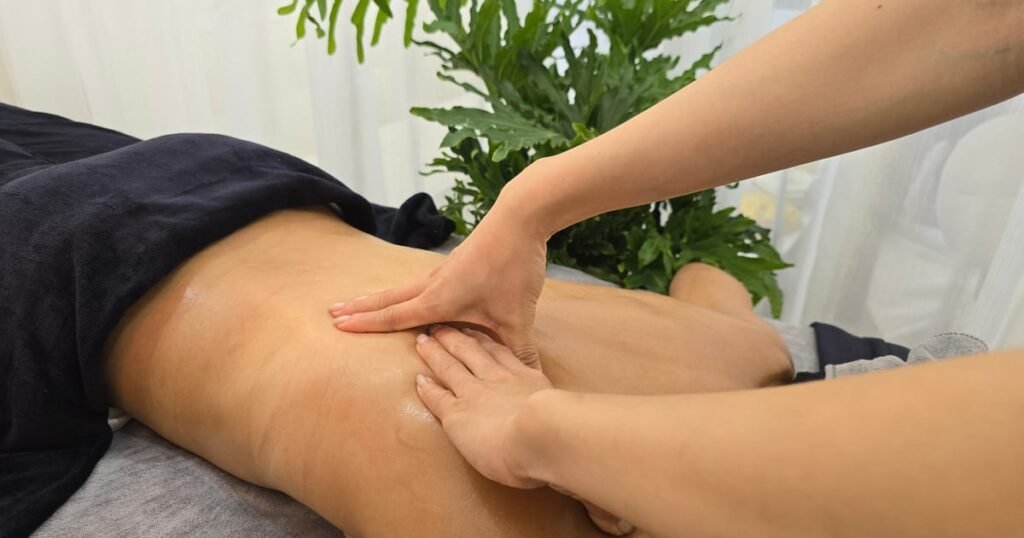
Sustained pressure on muscle triggers a measurable shift toward parasympathetic activity — heart rate slows, breathing deepens, muscle tone drops. It is the same mechanism as slow breathing, arriving from a different direction. The US National Center for Complementary and Integrative Health summarises what the evidence does and does not support.
This is the honest case for bodywork as stress management rather than as indulgence. It does not solve what is causing the stress. What it does is interrupt a sustained physiological state, and interruption matters, because chronic stress is partly a problem of never coming down.
For screen-driven head and jaw tension, scalp work is usually the most direct route. For the braced-shoulder pattern, therapeutic massage in District 1 targets it more effectively. If you want the longest possible unbroken stretch of downregulation, the quiet alley retreat at Chạm Spa in District 1, Ho Chi Minh City combines several treatments in one visit.
What Doesn’t Work: Scrolling, Alcohol, Pushing Through
Scrolling feels restful because it is passive, but it keeps you in a low-grade alert state — novelty, social evaluation, constant micro-decisions. An hour of it leaves your nervous system roughly where it started.
Alcohol shortens the time to fall asleep and degrades sleep quality substantially, particularly in the second half of the night. It is a sedative, not a sleep aid, and the rebound wakefulness around 3am is the cost.
Pushing through is the most expensive of the three. Ignoring accumulated stress does not clear it, and the path from sustained stress to burnout runs directly through the decision to keep going regardless.
A Wind-Down Routine for Hot Nights
Sixty minutes, and it works because each step is physical rather than intentional.
Ninety minutes before bed: last coffee long past, last heavy meal finishing. Turn the bedroom air conditioning on now so the room is genuinely cool by the time you get in it.
Sixty minutes before: cool shower. Not cold — cool. Change into loose cotton.
Thirty minutes before: screens off, or at minimum off social media and email. Dim the lights. This is the step people skip and the one that most affects how long it takes to fall asleep.
Ten minutes before: four-second inhale, eight-second exhale. Unclench your jaw — teeth apart, tongue on the roof of the mouth. Roll your shoulders back and down.
In bed: feet uncovered. Room around 24 to 26°C with air moving. Dark and quiet, using curtains and earplugs if the street requires it.
Conclusion
The useful reframe is that switching off is a physical process, not a mental one. Sleep needs your core temperature to fall. Calm needs a long exhale. Muscular tension needs pressure or movement, not insight. When you treat these as physical problems with physical solutions, they become far more tractable than when you treat them as failures of attitude.
Start with the two highest-leverage changes: cool the bedroom properly before you get into it, and do two minutes of extended exhales before sleep. Add the jaw check during the working day, because it costs nothing and most people are surprised by how often they are clenching.
And be honest about which state you are in. If rest is not restoring you, and it has been that way for months, that is not something to optimise a bedtime routine around — it is worth talking to a professional about.
Chạm Spa is a day spa at 82/20A Mạc Đĩnh Chi, District 1, Ho Chi Minh City, open Monday and Wednesday to Sunday, 10:00–19:30. Explore the premium head spa and therapeutic massage, or read more on the Chạm Spa Journal.
FAQ: Sleep, Stress and Switching Off
Why can’t I sleep when it’s hot?
Falling asleep requires your core body temperature to drop by around one degree, achieved by radiating heat out through your skin. When the surrounding air is nearly as warm as you are, that heat has nowhere to go and the temperature drop that triggers sleep does not happen. Cooling the room before bed matters more than cooling it at bedtime.
What’s the difference between burnout and being tired?
Tiredness responds to rest and burnout does not. After a genuine break, tiredness lifts; burnout feels the same on return. Burnout also brings detachment and cynicism about work you previously cared about, unrefreshing sleep, and an eroded sense of being effective regardless of what you actually produce.
Does massage reduce stress or just feel nice?
Both. Sustained pressure on muscle produces a measurable shift toward parasympathetic activity — slower heart rate, deeper breathing, lower muscle tone. It does not address the source of the stress, but it interrupts a sustained physiological state, and with chronic stress the inability to come down is a substantial part of the problem.
How do you stop clenching your jaw?
Start with awareness during the day. At rest your teeth should be slightly apart with your tongue on the roof of your mouth — check this a few times daily and you will notice how often they are together. Daytime clenching improves with repeated correction. Night clenching cannot be self-corrected and is worth raising with a dentist.
Does napping ruin your night sleep?
It depends on length and timing. Twenty to thirty minutes, finishing before mid-afternoon, generally does not affect night sleep. Naps beyond an hour, or later in the day, clear the sleep pressure you need to fall asleep at night, which is how a single long nap turns into several disrupted nights.
What temperature should a bedroom be in a tropical climate?
Around 24 to 26°C with air moving, rather than a very cold room with still air. Setting air conditioning too low commonly causes waking around 4am, when your body temperature is naturally at its lowest. Cooling the room well before you get into it matters more than the number, because walls and mattress hold heat.
Which treatment helps most with screen-related tension?
Scalp-focused work, usually. The muscles at the base of the skull connect through a continuous fascial layer to the scalp and forehead, so the tight-head sensation after a long screen day often releases more from scalp work than from neck work alone. Where the shoulders are also braced, a combination session covering both areas is the better use of the time.
If Chạm Spa has looked after you, it helps other guests to hear about it. Leave a review