At a therapeutic spa you undress to your comfort level, usually to underwear, and you are covered by a towel or sheet for the whole session with only the area being worked on uncovered. The therapist leaves the room while you change. You can ask for a female or male therapist, lighter pressure, or to skip any area, at any point.
Do you undress for a massage?
For an oil-based massage, you undress to underwear. Most people leave briefs on; almost nobody removes them. That is the standard everywhere from a budget shop to a hotel spa, and no therapist will be surprised or bothered by whatever you choose.
For clothed treatments — traditional Vietnamese tẩm quất, foot work, head and shoulder sessions — you either stay dressed or change into loose clothing the venue provides. Nothing comes off.
| Treatment | What comes off | What covers you | Where you change |
|---|---|---|---|
| Oil massage (relaxation, deep tissue, hot stone, aromatherapy) | Down to underwear; most people keep briefs on | Towel or sheet throughout, only the working area uncovered | Alone in the room, therapist outside |
| Traditional Vietnamese tẩm quất | Nothing — you stay dressed or change into loose clothing the venue provides | No draping needed | Alone, if you are changing at all |
| Foot massage and reflexology | Nothing | Light cover if you want one | Nowhere — you stay in a reclining chair |
| Head and shoulder sessions | Nothing | No draping needed | Nowhere |
“Undress to your comfort level” is the phrase venues use, and it means exactly what it says. If you want to keep more on, keep more on. The therapist works around it. A massage through a thin layer is slightly less effective and entirely acceptable.
There is no scenario in which you undress in front of the therapist. They leave the room, you change, you get under the towel or sheet, and they knock before coming back in.
How draping works
Draping is the practice that makes the whole thing straightforward, and almost nobody explains it to first-timers.
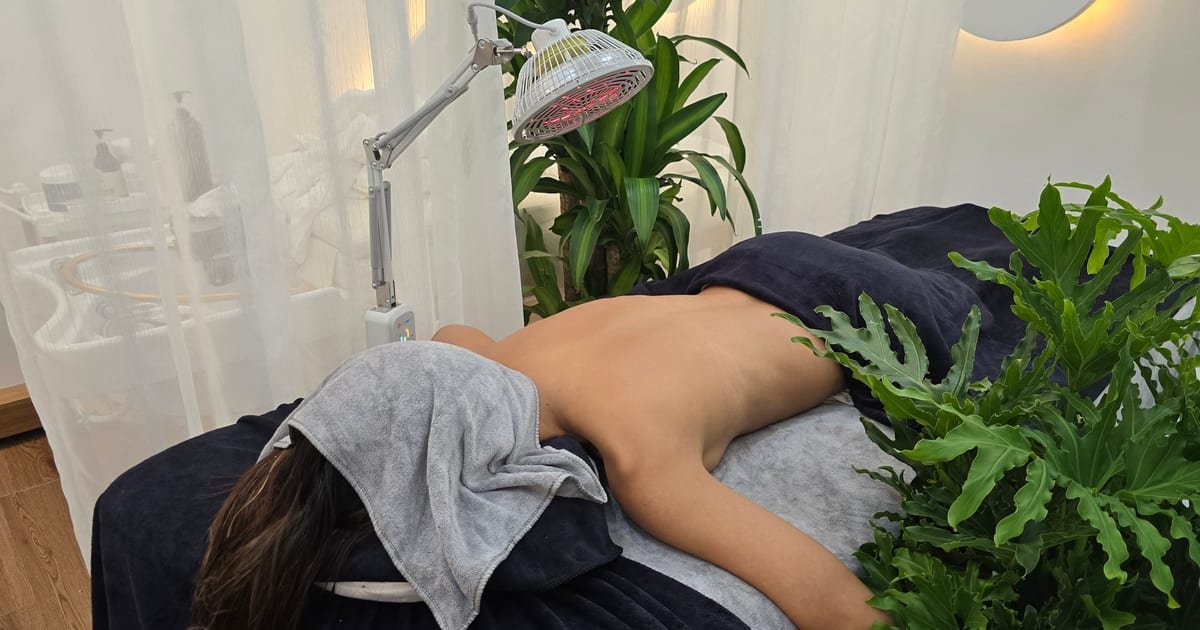
You lie under a towel or sheet. When the therapist works your back, the sheet folds down to your waist. When they move to a leg, that leg is uncovered and folded back over before they move to the other one. At no point is more than the working area exposed, and you are covered continuously when you turn over.
Standards vary by tier. A private room at a spa uses a full sheet and formal draping. A curtained bay at a budget venue may use a smaller towel and a looser approach. Both are normal.
What is not normal is no draping at all. Where massage is licensed, draping is a written rule. A venue that expects you to lie uncovered for an oil massage is not operating as a therapeutic spa — our guide to finding a legitimate massage spa in District 1 covers what else to check.
What happens in the first five minutes
Naming the sequence removes most of the anxiety, so here it is in order.
You arrive and take your shoes off, usually swapping into slippers at the door. Reception confirms the treatment, duration and price. You are asked something about your body — where you hold tension, how firm you like the pressure, whether you have any injuries, whether you are pregnant. That intake question is the single clearest sign you are somewhere professional.
Your valuables go into a locker, a lockable drawer, or a basket that comes into the room with you. You are shown to the room and left alone. You change, lie face-down under the sheet with your face in the cradle, and wait. The therapist knocks before entering.
The whole sequence takes under five minutes and it is the same at every reputable venue in the city.
What you can ask for
Most first-timers do not realize how much of the session is theirs to direct. All of the following are ordinary requests that a professional therapist expects and will not find rude.
A female or male therapist. Ask when you book, not at reception — you have more leverage and no audience. Most therapists at District 1 spas are women; male therapists are more common for deep tissue work.
Lighter or firmer pressure. At any point, as many times as you like. A therapist who checks in during the first few minutes is doing their job properly.
To skip an area entirely. Feet, glutes, scalp, abdomen, face, anywhere. You do not need a reason. “Please skip my feet” is a complete instruction.
More or less conversation. Say so at the start.
Room conditions. Temperature, music volume, lighting. Vietnamese spa rooms are frequently air-conditioned to a level Western visitors find cold, and asking for it warmer is the most common request of all.
To stop. At any point, for any reason. The session ends, you get dressed, you pay for the time used.
If a request is met with reluctance, that is information about the venue rather than about whether the request was reasonable.
Do you talk during a massage?
Either is fine and both are common. Say what you prefer in the first minute — “I’d rather just relax” is enough, and no therapist takes it personally.
What is worth answering properly is the pressure check. When a therapist asks whether the pressure is okay, they want a real answer, not politeness. “A bit firmer on the shoulders” gives them something to work with; “it’s fine” gives them nothing.
Falling asleep is normal, extremely common, and not rude.
Male and female therapists
Most therapists working in Ho Chi Minh City spas are women. Male therapists are more common at tẩm quất venues and for deep tissue work, where sustained pressure is the point.
Mixed-gender pairings are unremarkable at a therapeutic venue and nobody will think anything of a request either way. The only practical note is to make the request at booking rather than on arrival, because staffing on the day may not allow a swap.
Our guide for solo female travelers getting a massage in Ho Chi Minh City covers this in more detail, including what to put in the booking message.
Afterwards
Drink water. Mild soreness for a day after genuinely deep work is normal and is not injury — it is the same soreness as after unfamiliar exercise. US health authorities rate the risk of harm from massage as low.
Avoid a heavy meal immediately beforehand and do not book strenuous exercise straight after. Beyond that there is no aftercare ritual, whatever a spa brochure may suggest.
If you are choosing between treatments and unsure which suits you, our overview of massage therapies in District 1 sets out how each one creates release — a relaxation massage with oil is the standard recommendation for a first session, and pregnancy massage uses side-lying positioning from the second trimester onward. Lying flat can compress the vena cava after about 20 weeks.
Frequently asked questions
Do you take all your clothes off for a massage?
No. For an oil massage you undress to underwear, and most people keep briefs on. For clothed treatments such as traditional Vietnamese massage, foot work or head and shoulder sessions, you stay dressed or change into clothing the venue provides. You always change alone, with the therapist out of the room.
What should I wear to a massage?
Whatever is comfortable and easy to remove. You will change at the venue, so loose clothing helps. For clothed treatments, avoid jeans and anything restrictive. Leave jewelry and your passport at the hotel — you need neither, and both are easier to lose than to replace.
Can I ask for a female massage therapist?
Yes, and it is a routine request. Ask when you book rather than at reception, so the venue can staff the session accordingly. Most therapists at District 1 spas are women in any case, but making the request in writing removes any uncertainty on the day.
Is it normal to fall asleep during a massage?
Completely normal and very common, particularly during a relaxation or aromatherapy session. Therapists expect it and it does not interrupt their work. You may wake slightly disoriented, which is why most venues leave you a few minutes to sit up before offering water or tea.
Should I shower before a massage?
It is courteous but not required, and no venue will comment either way. Arriving straight from a hot day of walking is entirely ordinary in Ho Chi Minh City. Some spas offer a shower on site; ask at booking if that matters to you.
Can I stop a massage partway through?
Yes, at any point and for any reason. Say stop, and a professional therapist stops immediately. Get dressed, go to reception and pay for the time actually used at the menu rate. You are not obliged to explain yourself or to negotiate.
Chạm Spa offers massage in Ho Chi Minh City District 1, near Mạc Đĩnh Chi. Every session starts with a short conversation about pressure and problem areas, rooms are private, and you can book online with a therapist preference noted in advance. We are closed on Tuesdays.
If Chạm Spa has looked after you, it helps other guests to hear about it. Leave a review