In an aromatherapy massage the oil is doing two jobs, and only one of them is well evidenced. Oil lets a therapist’s hands move in long unbroken strokes that a dry massage cannot manage, and that is the mechanical reason it is used. The claim that the scent itself acts on a condition is a much bigger claim, and a much thinner one. At Chạm Spa the oil treatments are Relaxation Massage with Oil, 60–90 Mins at 270,000 ₫ – 400,000 ₫, and Warm Candle Relaxation Massage, 60–90 Mins at 290,000 ₫ – 420,000 ₫.
Why oil is used at all
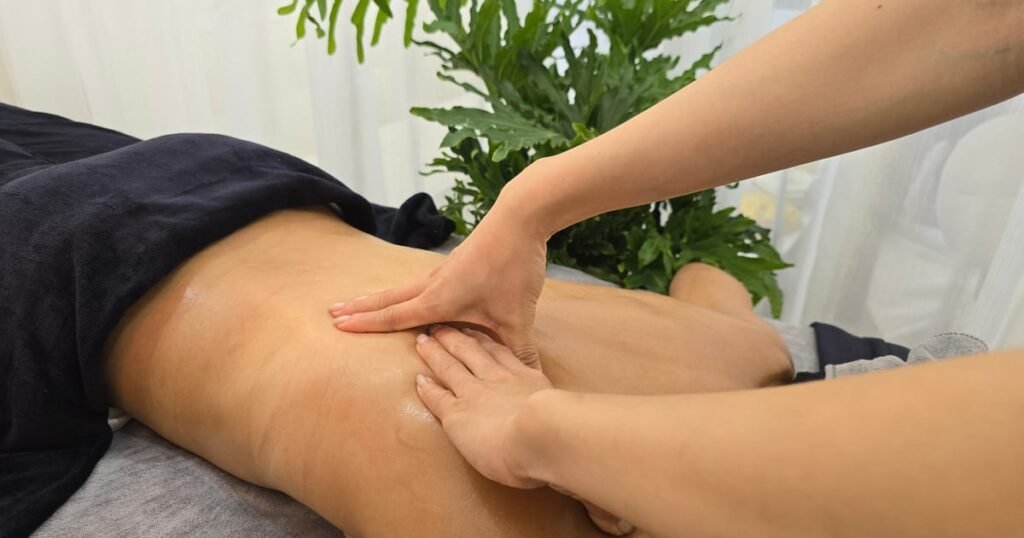
Skin against skin has friction. A dry massage works around it: the hands press, move a short distance, lift, reposition, press again. The stroke is broken by definition. Add oil and a hand travels the length of a back or a whole leg in one pass, at a constant speed, without dragging the skin with it.
That is what people mean when they say an oil massage feels flowing and a dry one feels worked. Long, slow, predictable strokes are the part most people find settling. The oil is not doing the work. It removes the interruption.
How much gets used is a therapist’s judgement, not a fixed quantity, and it is adjustable. If you want less, or none near your hairline, say so in the first two minutes rather than the last ten. Draping and what you can ask for covers how that conversation goes.
Aroma massage, oil massage, candle massage: what actually differs
Aroma massage is a menu word, not a regulated technique. On most spa menus in Ho Chi Minh City it means a full-body massage with a scented oil at light to moderate pressure. The treatment that corresponds to it at Chạm Spa is Relaxation Massage with Oil. Searching for one and landing on the other is not a redirect.
| Treatment | Duration | Price | What the oil is for | Pressure |
|---|---|---|---|---|
| Relaxation Massage with Oil | 60–90 Mins | 270,000 ₫ – 400,000 ₫ | Glide, so strokes run long and unbroken | The gentlest starting point on the menu |
| Warm Candle Relaxation Massage | 60–90 Mins | 290,000 ₫ – 420,000 ₫ | Glide, plus heat delivered by the pour itself | Light to moderate, with heat |
| Deep Tissue Massage | 60–90 Mins | 290,000 ₫ – 420,000 ₫ | Not the point; pressure is | Firm and slow, through the deeper muscle layers |
| Hot Stone Therapy Massage | 60–90 Mins | 300,000 ₫ – 440,000 ₫ | Not the point; heat is | Heated basalt stones and hand massage, so less pressure is needed |
The line runs between the first two rows and the last two. The first pair are flowing whole-body treatments where scent is part of the experience; the second pair are targeted work where scent is incidental. For the wider survey, how it compares with the other styles sets them side by side.
What aromatherapy claims, and what has been shown
Aromatherapy means using essential oils, inhaled or applied to the skin, with a therapeutic intention. The claims made for it in spa marketing are frequently large and frequently specific. The research is neither.
The US National Center for Complementary and Integrative Health says this on its aromatherapy overview: “One study of aromatherapy using two contrasting scents, lemon and lavender, in people under stress found that lemon had a positive effect on mood but neither scent affected stress indicators, biochemical markers of immune system changes, or pain control.”
In that study what moved was how people said they felt; the biochemical and pain measures did not. A scent may change your mood in a quiet room for an hour. That is a real effect, and a small one, and it is not an effect on a condition.
So we will not tell you a scented oil acts on your immune system, your hormones or your pain. We will tell you that an hour of long slow strokes in a dark room, with something that smells good in the air, is what most people say leaves them feeling better than they arrived.
The candle version, and what warmth changes
The warm candle massage uses a massage candle: the oil is melted and poured onto the skin, then worked in, so heat, scent and touch arrive together.
What changes is smaller than the name suggests, and worth knowing before you pay 290,000 ₫ – 420,000 ₫ rather than 270,000 ₫ – 400,000 ₫. The pressure is not firmer; the treatment page’s own claim is that the heat lets a therapist work deeper without pushing harder. The pour is the distinct part, and it is a sensation some people like and some find distracting.
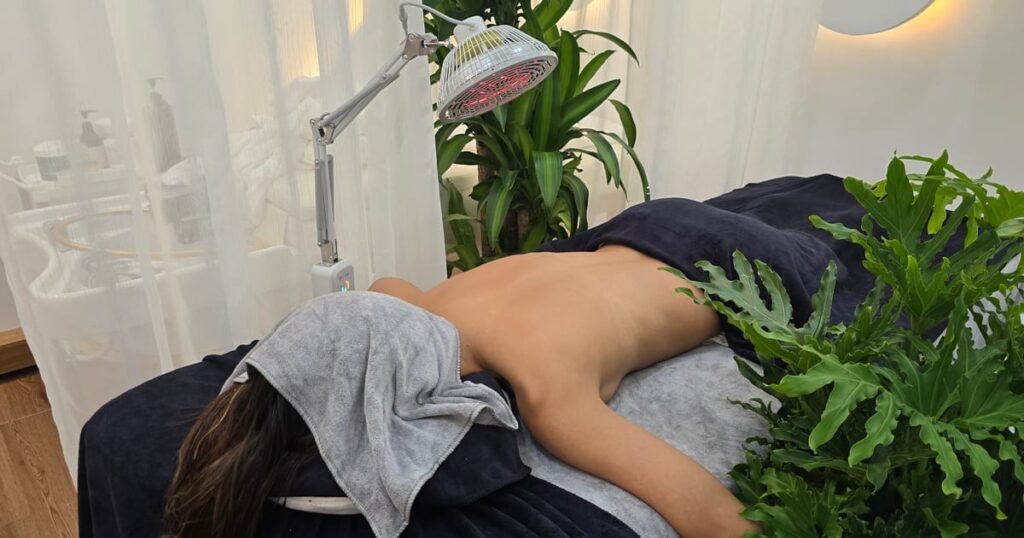
The temperature is meant to be comfortable on skin. If it is not, say so on the first pour rather than enduring it. If it is heat you are really after rather than scent, heat instead of pressure carries more of it: the stones soften muscle so less pressure is needed to reach it.
Who it suits, and who should book something else
An oil or candle massage suits a first visit, a body that is generally tight rather than specifically injured, a long day walking the city, and anyone who dislikes strong pressure. Book it when the answer to “where does it hurt” is “everywhere, mildly”.
It is the wrong purchase for one stubborn knot. Flowing strokes cross a problem area without staying on it, and 90 minutes of crossing it will not do what sustained work on the spot does. If you came in for one shoulder, book firmer, slower work on one area at 290,000 ₫ – 420,000 ₫ instead.
Skin is the other reason to choose differently, because oil sits on it for hours and scented products do not suit everyone. NCCIH notes that “topical products containing lavender may cause allergic skin reactions in some people” — a statement specific to lavender rather than a verdict on scented oils generally, but a good reason to mention any reaction you have had before the session rather than after. Broken skin, sunburn, a fresh wax or an active rash are worth raising at reception.
NCCIH’s overview of massage therapy puts it plainly: “The risk of harmful effects from massage therapy appears to be low,” with rare reports of serious side effects such as a blood clot, nerve injury or bone fracture. Its advice is that if you are unsure whether massage therapy would be appropriate for you, you discuss it with your health care provider. A spa is not a clinic, and that conversation is not ours to have.
Oil, hair and clothes: the practical part
You will not leave dripping, but you will leave with a film on your skin, and it does not vanish at the door.
Clothes. Wear something you would not mind marking. Linen and silk take oil badly; dark cotton does not care.
Hair. Oil near the hairline is easy to avoid and easy to forget to mention. If your hair is freshly washed, say so before you lie down.
Scent. A shower afterwards takes off the residue and most of the smell with it. Leaving it is also fine, but it will still be faintly on you hours later, which is worth a thought if you have dinner or a meeting.
Timing. Chạm Spa is open 10:00 to 19:30 and closed Tuesdays, so a 90-minute session has to start by 18:00.
So which one should you book?
If you have never had a full-body massage, or you want the whole body handled evenly, book the Relaxation Massage with Oil. It is the least demanding thing on the menu and it does what it says.
If warm oil poured onto your back appeals, the candle version is that treatment with the pour added, at a slightly higher price. If it does not, what you are skipping is the pour and its warmth, not a scent-based therapeutic effect. And if you are hoping the scent will fix something specific, adjust the expectation rather than the booking: the massage is the part with the evidence behind it.
Chạm Spa is a day spa at 82/20A Mạc Đĩnh Chi, Tân Định Ward, District 1. Every treatment page carries its price up front rather than a quote on arrival. Open 10:00–19:30, closed Tuesdays; the full massage menu lists each treatment with its length.
Frequently asked questions
Does aromatherapy massage actually treat anything, or does it just smell good?
The massage is the part with the better evidence behind it. One study cited by NCCIH, using lemon and lavender in people under stress, found lemon had a positive effect on mood while neither scent affected stress indicators, immune markers or pain control. A scented oil massage may help you relax. It is not treatment for a condition.
What is the difference between an oil massage and a candle massage?
Delivery, not technique. Relaxation Massage with Oil uses warm oil applied by hand, 60–90 Mins at 270,000 ₫ – 400,000 ₫. Warm Candle Relaxation Massage uses warm massage-candle oil poured onto the skin and worked in, 60–90 Mins at 290,000 ₫ – 420,000 ₫. The pressure is not firmer with the candle.
Will I leave the spa covered in oil?
No. Most of it is worked in over the session and what remains is a light film. Your clothes may pick some up, so wear something forgiving. If you want it gone immediately, rinse before you leave.
Can I ask for less oil?
Yes, and it is a normal request. The quantity is a therapist’s judgement rather than a fixed measure, so it can be reduced, kept away from your hair, or kept off a particular area. Ask at the start rather than at the end, as you would for pressure or for an area you want skipped.
Is oil massage a bad choice if my skin breaks out easily?
Not automatically, but raise it at reception before the session rather than afterwards. Oil stays on the skin for hours. NCCIH notes that “topical products containing lavender may cause allergic skin reactions in some people” — a statement about lavender specifically rather than about scented oils generally, but a reason to raise any reaction you have had before. A therapist can work around an area, and rinsing at the end removes most of the residue.
Should I wash my hair after an aromatherapy massage?
Only if oil reached it. A full-body massage does not need to involve your hairline at all, and if you say so beforehand it usually will not. If some did get in, ordinary shampoo handles it, occasionally with a second wash.
Is aroma massage strong enough for a knot in my shoulder?
Usually not. Long flowing strokes cross the area rather than settling on it, and that is the treatment working as designed rather than a therapist going easy on you. For one persistent spot, Deep Tissue Massage at 290,000 ₫ – 420,000 ₫ for 60–90 Mins is the right booking.
If Chạm Spa has looked after you, it helps other guests to hear about it. Leave a review