On a Vietnamese spa menu, trị liệu means a firm, targeted massage and thư giãn means a gentle, whole-body one — neither word is a medical claim. Trị liệu is the category most menus are organized under, and it also sits inside the names of the deep tissue and hot stone treatments; thư giãn is the relaxation massage filed beneath it. Chạm Spa’s own listing describes the business as a day spa, “not a medical clinic; treatments are cosmetic and relaxation-focused.”
What a Vietnamese spa menu means by trị liệu and thư giãn
Trị liệu translates as therapy or treatment, and that is as far as it goes: on a menu it is the heading the firmer, targeted work sits under. Thư giãn translates as relaxation and names the gentle, full-body massage every spa in the city sells. One is a category, the other an item inside it, and a single menu often uses the first word both ways.
The clearest proof is our own menu in Vietnamese. The category page is titled Massage Trị Liệu & Cổ Vai Gáy, opens with the English page’s line in Vietnamese, and labels its first card Thư Giãn (60–90 Phút): at the top of the page, trị liệu simply means “the massage range.” Lower down it narrows into two treatment names, Massage Trị Liệu Chuyên Sâu (Deep Tissue Massage) and Massage Đá Nóng Trị Liệu (Hot Stone Therapy Massage), and into a package name, Traditional Relaxation (Trị Liệu Cổ Truyền). A label, then, not a promise. Vietnamese readers have their own comparison; this is what the two words buy, quoted from the two live treatment pages:
| Menu word | Pressure | Area covered | Purpose | What to expect afterward |
|---|---|---|---|---|
| Trị liệu — Deep Tissue Massage, 60–90 Mins, 290,000 ₫ – 420,000 ₫ | “Firm to strong, adjustable at any point” | Targeted: “covers less ground than a relaxation massage” | “Corrective work rather than pampering” | “Possible mild soreness for 24–48 hours” |
| Thư giãn — Relaxation Massage with Oil, 60–90 Mins, 270,000 ₫ – 400,000 ₫ | “Light to medium — never deep” | “Back, legs, arms, neck and shoulders” | “No deep pressure and no corrective agenda” | No soreness listed; “the warm oil leaves skin noticeably softer” |
Neither row is the better purchase; they answer different requests. The six massage treatments and what they cost are on the English menu page if you would rather book than read on.
The same six treatments under two names
A Vietnamese menu and its English twin usually list the same treatments, and the Vietnamese name often says more about the pressure. These are ours, matched across the two hubs.
| On the Vietnamese menu | On the English menu |
|---|---|
| Massage Thư Giãn Tinh Dầu | Relaxation Massage with Oil |
| Massage Trị Liệu Chuyên Sâu | Deep Tissue Massage |
| Massage Nến Thơm Ấm | Warm Candle Relaxation Massage |
| Massage Đá Nóng Trị Liệu | Hot Stone Therapy Massage — heat replaces some of the pressure |
| Massage Bầu | Pregnancy Massage |
| Massage Cổ Vai Gáy Chuyên Sâu | Deep Tissue Neck & Shoulder Massage |
Chuyên sâu (in depth) and mô sâu (deep tissue) both flag the firm, slow style. Tinh dầu is oil, đá nóng is hot stone, nến thơm is scented candle, bầu is pregnancy. Tẩm quất, the word on street signs, is a venue type and not a menu item; what the signage means decodes the sign on the door, where this page decodes the menu.
What happens when you ask for trị liệu
Ask for trị liệu at a day spa and the nearest item on our menu is Deep Tissue Massage, whose page sets out what a deep tissue session involves in four steps.
- You describe the problem. Where the pain sits and how long — the usual intake conversation, only more specific.
- Warming the area. Broader, lighter strokes first, so full pressure never goes into cold muscle.
- Focused release. “Slow strokes along the muscle fiber, thumb and forearm pressure held on trigger points, and steady work through the fascia.”
- Flush and finish. Lighter strokes to settle everything down, plus advice for home.
One line from that page explains the word: “The difference between deep tissue and an ordinary firm massage is not simply more force. It is pace.” If you are holding your breath or gripping the table, it is too much — “more pressure is not a better massage.”
Dưỡng sinh: the third word, and why it is not a massage type
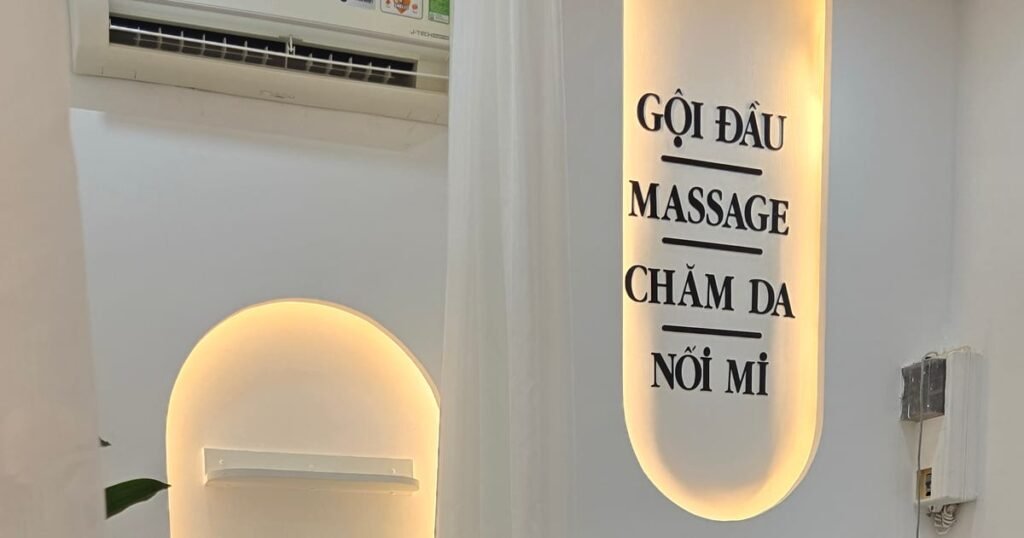
Dưỡng sinh attaches to hair washing (gội đầu dưỡng sinh) and to head treatments, never to a pressure level. Our comparison of head spa or gội đầu dưỡng sinh says it “translates roughly as nurturing daily life, and it is attached to a range of ordinary Vietnamese well-being practices rather than to one technique” — a routine, not a treatment. The Đông y thinking behind the words and the head spa menu cover the rest.
“Health massage,” “therapy massage,” and the words that mean nothing in particular
English-language menus in Saigon are translations, and translations leak. “Health massage” is usually massage sức khỏe or massage trị liệu rendered word for word; “therapy massage” is the same source word through a different translator. None names a technique, a pressure, or an outcome. Read the Vietnamese line beneath, find chuyên sâu, thư giãn, or đá nóng, and go by that.
The English word is just as loose at home. The US National Center for Complementary and Integrative Health opens its guidance on massage therapy with “The term ‘massage therapy’ includes many techniques,” from Swedish to sports and clinical massage to Shiatsu. So “therapy” on a menu is a heading, not a medical claim, in either language — on a Saigon menu it simply points you to the firmer, more targeted items.
Names you will not find on a Saigon day-spa menu
Most of the vocabulary visitors bring from home is not printed anywhere in the city.
| Name you might search | What it is | On a Saigon day-spa menu? | Where to read more |
|---|---|---|---|
| Trigger point | A bodyworker’s word for the knot; Wikipedia calls the science “a topic of ongoing controversy” | Only as the deep-tissue page’s word for one step | Deep Tissue Massage |
| Remedial massage | A name used in some countries for targeted, firm bodywork | No; deep tissue is the nearest match | Every technique on a Vietnamese menu, explained |
| Sports massage | Firm work organized around training | No; deep tissue is the nearest match | Types of massage explained |
| Manual lymphatic drainage (MLD) | Skin manipulation that Wikipedia describes as “not to be confused with massage” | No; a clinical service, and not on ours | The types page |
| Physiotherapy (physio, physical therapy) | A clinical plan in which massage is one tool | No | The NHS on physiotherapy |
| Facial gua sha | The one lymphatic item on the menu, “deliberately light”; its claim is cosmetic — it “drains lymphatic fluid to reduce puffiness” | Yes, as a 60-minute facial; not MLD | Facial gua sha |
When to see a clinic instead of asking for trị liệu
Because trị liệu translates as therapy, it can tempt a visitor with a real problem to book deep tissue instead of seeing a doctor. The NCCIH guidance above is direct: “Don’t use massage therapy to postpone seeing a health care provider about a medical problem.”
The UK’s NHS describes physiotherapy as “a treatment that can ease pain and improve movement if you have an injury, illness or disability,” with massage listed as one technique alongside exercise. There, massage is one tool inside an assessed plan; on a spa menu it is the whole item. UK guidance, but the line it draws holds anywhere.
The deep-tissue page draws the same line: tell your therapist first if you are “pregnant, have a recent injury, swelling, blood-clotting concerns, osteoporosis, or are taking blood thinners,” and in pregnancy “choose Pregnancy Massage instead.” If no clinician has looked at the reason you want trị liệu, make that appointment first.
Two words, and the rest is a menu
Read trị liệu as the firm, targeted one and thư giãn as the gentle one filed under it, and a Saigon menu stops being a puzzle. Dưỡng sinh is a routine, not a pressure; “health massage” is a Vietnamese heading run back through a translator; trigger point, remedial, and sports lead to deep tissue as the nearest match; MLD and physiotherapy lead out of the spa. How to say which one you want when booking covers the rest.
Chạm Spa prints the same six massage treatments on its Vietnamese and English menus. We are at 82/20A Mạc Đĩnh Chi in Tân Định Ward, District 1, Ho Chi Minh City. Open 10:00–19:30, closed Tuesdays.
Frequently asked questions
On a Vietnamese spa menu, does “massage trị liệu” mean a medical treatment?
No. Trị liệu translates as therapy or treatment, and on a menu it labels the firmer, targeted massages and sometimes the whole range. Chạm Spa’s listing describes a day spa that is “not a medical clinic; treatments are cosmetic and relaxation-focused,” which covers every item carrying the word.
Is “massage thư giãn” the same thing as a Swedish massage?
Close enough to book on. Thư giãn means relaxation, and on our menu it names the Relaxation Massage with Oil, whose page lists “Swedish-style flowing strokes with warm oil” at “light to medium — never deep.” The word describes the intent; the technique underneath is Swedish.
Why does a menu list “thư giãn” underneath a “trị liệu” heading?
Because the heading uses the word broadly, as “the massage range,” and the item beneath it narrowly, for the firmer style. Our own Vietnamese menu page is titled Massage Trị Liệu & Cổ Vai Gáy and its first card is Thư Giãn (60–90 Phút).
Is “health massage” on an English-language Saigon menu a specific technique?
No. It is usually massage sức khỏe or massage trị liệu translated word for word, and it tells you which heading the item sat under, not what the therapist will do. Look for the Vietnamese line beneath it, or ask which of the six treatments it is.
Can I ask a Saigon day spa for a trigger point or remedial massage?
You can ask, and you will most likely be offered deep tissue — the nearest day-spa match for targeted firm work. “Trigger point” is already the deep-tissue page’s own term for its focused-release step; there is no item called remedial or sports massage on our menu.
Is facial gua sha the same as manual lymphatic drainage?
No. Manual lymphatic drainage (MLD) is a clinical technique that Wikipedia describes as “not to be confused with massage,” and it is not on our menu. Facial gua sha is a 60-minute facial with a stone tool, “deliberately light” — cosmetic, not clinical.
Should I ask a spa for trị liệu, or see a physiotherapist, for an injury?
See a clinician first. The NCCIH says not to use massage therapy to postpone seeing a health care provider about a medical problem, and the deep-tissue page asks you to mention a recent injury, swelling, clotting concerns, osteoporosis, blood thinners, or pregnancy before the session. A spa session can follow an assessment, not replace it.
If Chạm Spa has looked after you, it helps other guests to hear about it. Leave a review